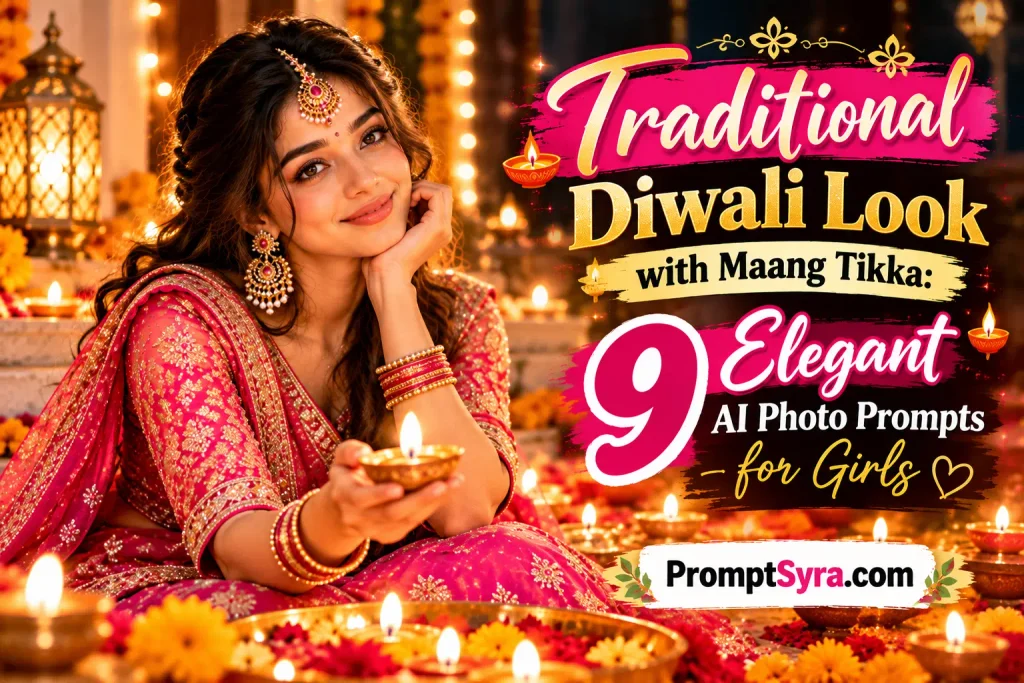
The maang tikka is one of the most recognizable pieces of traditional Indian jewelry — and one of the most inconsistently rendered in AI image generation. A well-written traditional Diwali look with maang tikka AI photo prompt produces a realistic, detailed portrait with the ornament correctly placed at the hair parting and resting on the forehead. A vaguely written one can result in a misplaced pendant, a decoration that looks like a bindi, a missing chain, or random forehead ornamentation that doesn’t correspond to the actual jewelry.
This article addresses that specific challenge. Before the 9 prompts, a short section explains how to describe a maang tikka accurately in an AI prompt — the structural details that differentiate it from similar ornaments and that most generic prompts leave out. Each of the 9 prompts then uses a distinct composition, lighting setup, and visual goal so the collection covers genuinely different portrait outcomes.
Describing a Maang Tikka Accurately in an AI Prompt
Most AI tools need explicit structural description to render jewelry correctly. The maang tikka has a specific physical structure that is easy to describe once you understand it.
What a maang tikka consists of:
A pendant (the tikka itself) — a decorative medallion, teardrop, or floral piece that rests on the center or slightly off-center of the forehead
A chain or string that runs from the pendant along the hair parting (the “maang,” meaning the parting or center line of the hair)
A pin, clip, or attachment point where the chain is secured into the hair at the parting — typically at the top of the center part or at a side parting
What a maang tikka is not: It is not a bindi (which is applied directly to the forehead skin). It is not a nose ring. It hangs from the hair — the chain is in the hair, the pendant falls onto the forehead from above.
The sentence that consistently improves results: Add this or a version of it to any prompt: “She wears a traditional maang tikka: a decorative pendant resting on the center of her forehead, attached by a fine chain that runs along her hair parting into her hair.”
That one sentence — specifying pendant, chain, and hair parting — is the single most useful addition to any maang tikka portrait prompt. The 9 prompts below all include it.
9 AI Photo Prompts — Traditional Diwali Look with Maang Tikka
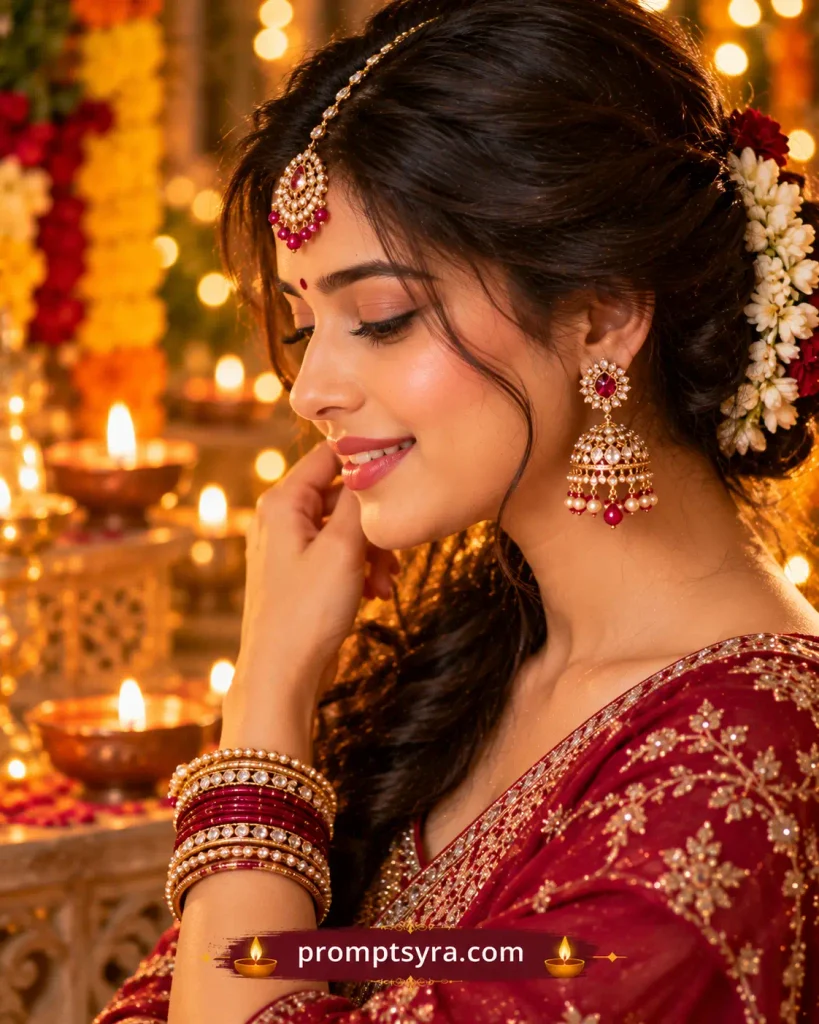
Prompt 1: Profile Portrait — Tikka Chain Visible Along the Parting
A side profile composition where the maang tikka chain is clearly visible running along the hair parting from the forehead toward the top of the head. The pendant rests against the forehead at the near edge of the profile. This is the composition where the tikka’s full structure — chain and pendant together — is most clearly readable because the side angle separates them from the face.
| Image Detail | Specification |
|---|---|
| Subject | Young woman, profile view, traditional Diwali look |
| Maang Tikka | Chain visible along hair parting; pendant at forehead |
| Visual Style | Clean profile portrait — jewelry detail emphasis |
| Lighting | Soft directional side light from the near side |
| Aspect Ratio | Vertical 4:5 |
| Image Quality | High-quality, detailed, realistic image |
Realistic traditional Diwali portrait of a young Indian woman in side profile facing left. She wears a traditional maang tikka: a decorative pendant resting on the center of her forehead, attached by a fine gold chain that runs visibly along her hair parting toward the top of her head. Her hair is styled in a neat center-parted bun or braid so the tikka chain is clearly visible against the hair. She wears a richly embroidered lehenga or saree in a jewel tone such as deep red, emerald, or royal blue. She also wears matching traditional earrings. The lighting is soft and directional from the near side — illuminating her face and the tikka pendant clearly. The background is simple and softly blurred — warm neutral or a soft Diwali interior. Profile composition: the full side of her face is visible. Output quality: High-quality, detailed, realistic image. Aspect ratio: Vertical 4:5 format.
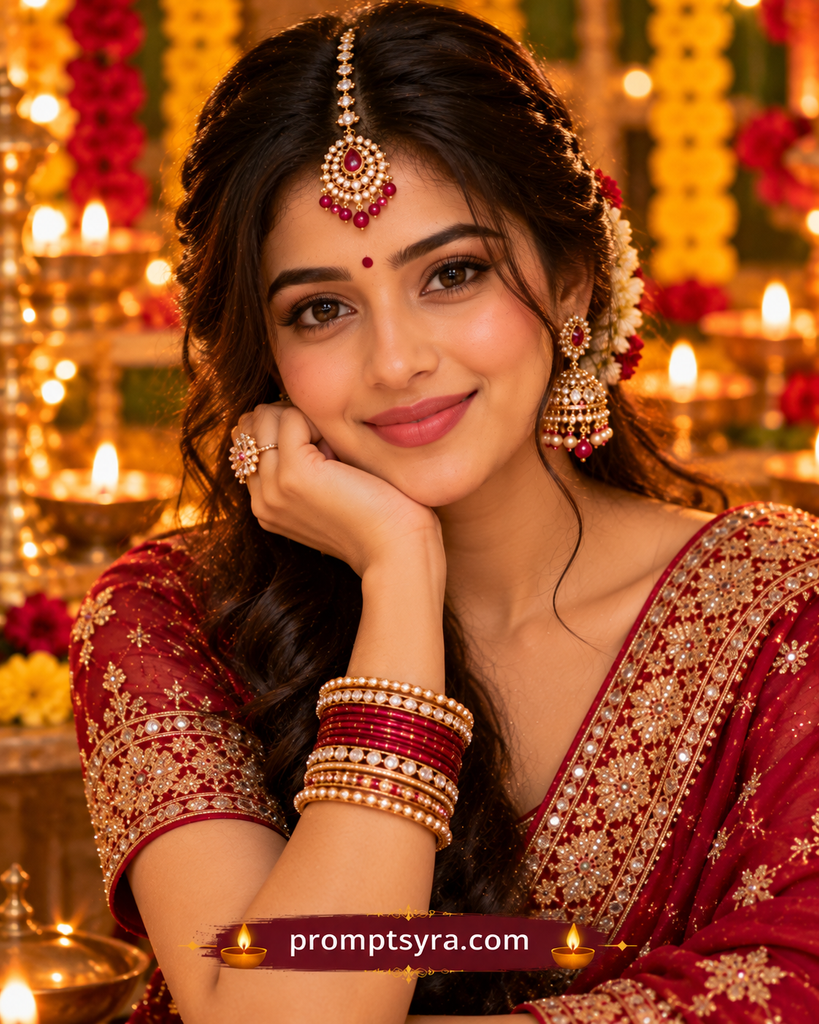
Prompt 2: Straight-On Close Portrait — Tikka Centered on Forehead
A direct front-facing close portrait where the subject looks into the camera. The maang tikka pendant is centered on the forehead, clearly visible. The frame is tight — from the shoulders to just above the hair, including the tikka pinpoint. This prompt is focused on the face and jewelry together: a clean, formal portrait composition with all the traditional Diwali accessories visible.
| Image Detail | Specification |
|---|---|
| Subject | Young woman, direct front-facing close portrait |
| Maang Tikka | Centered pendant on forehead; chain into center-parted hair |
| Visual Style | Formal traditional Diwali close portrait |
| Lighting | Soft even frontal light — no harsh shadows |
| Aspect Ratio | Vertical 4:5 |
| Image Quality | High-quality, detailed, realistic image |
Realistic traditional Diwali close portrait of a young Indian woman facing the camera directly. She wears a traditional maang tikka: a decorative pendant centered on her forehead, attached by a fine gold chain running along her center hair parting into her styled hair. Her hair is parted in the center and pulled back or up, making the tikka chain clearly visible. She wears a heavily embroidered lehenga blouse or saree in a rich festive color — deep red, maroon, or gold. Full traditional jewelry: matching jhumka earrings, bangles visible at the wrist, and a nath (nose ring) optional. Her expression is composed and confident, looking directly at the camera. Soft even frontal lighting — no strong shadows. The frame runs from shoulders to just above the tikka pin point in the hair. Simple, warm blurred background. Output quality: High-quality, detailed, realistic image. Aspect ratio: Vertical 4:5 format.
Prompt 3: Downward Gaze — Tikka Pendant Falls Against Forehead
The subject’s eyes are cast downward — looking at her hands, a diya, or simply downward in a contemplative pose. This angle causes the maang tikka pendant to fall naturally toward the lower forehead, and the chain becomes visible arching across the hair parting. The downward gaze reveals the full top of the head and hair styling in a way that a forward-facing portrait does not.
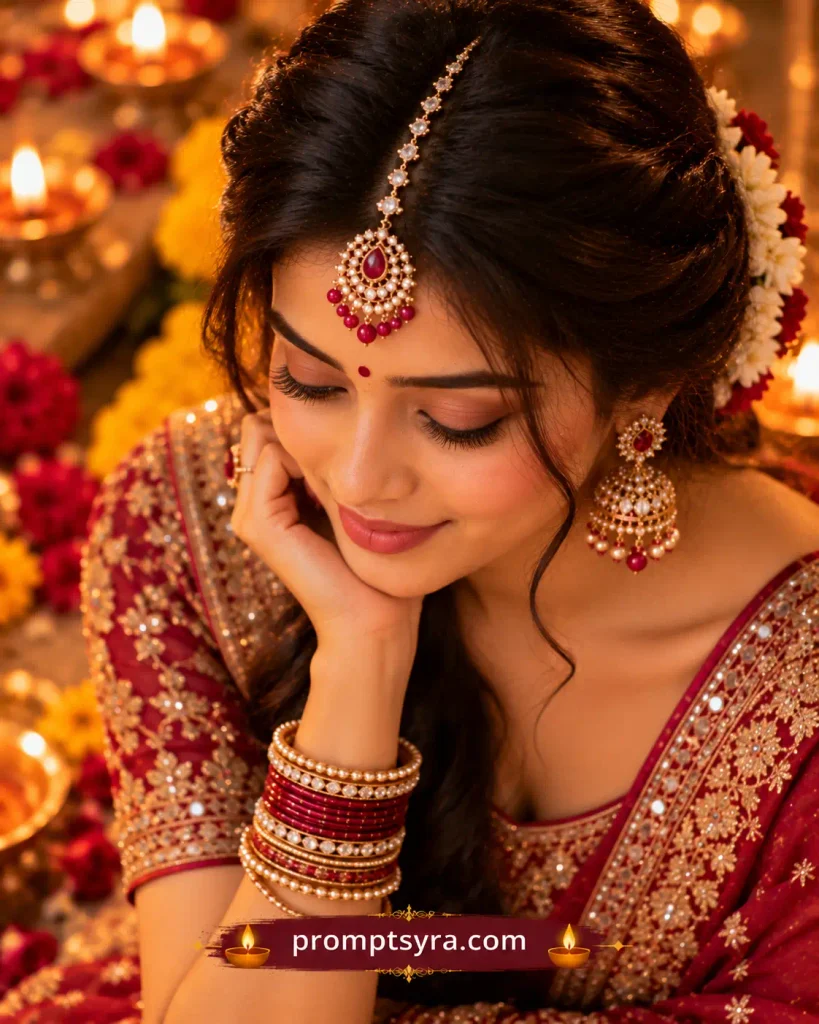
| Image Detail | Specification |
|---|---|
| Subject | Young woman, eyes downward, contemplative expression |
| Maang Tikka | Pendant falling naturally on forehead; chain arc visible from above |
| Composition | Slight overhead angle to show tikka and hair parting from above |
| Lighting | Soft overhead or 45° directional — emphasizes jewelry detail |
| Aspect Ratio | Vertical 4:5 |
| Image Quality | High-quality, detailed, realistic image |
Realistic traditional Diwali portrait of a young Indian woman with her eyes cast softly downward. She wears a traditional maang tikka: a decorative pendant resting on her forehead, attached by a fine chain running along her hair parting — the chain and pin point are visible from the slight overhead angle. The camera is positioned slightly above eye level so the top of her hair, the tikka chain, and the pendant are all clearly visible. Her expression is calm and introspective. She wears a richly embroidered lehenga or saree blouse with traditional jewelry including earrings and bangles. The lighting comes from a soft 45° source above and in front — illuminating the tikka pendant and the hair detail from above. Background is warm and softly blurred. Output quality: High-quality, detailed, realistic image. Aspect ratio: Vertical 4:5 format.
Prompt 4: Full-Figure Traditional Ensemble — Complete Diwali Look
A full-body or three-quarter shot that shows the complete traditional Diwali outfit — not just the face and jewelry. The maang tikka is visible in the full-figure frame as part of the complete look: lehenga, dupatta, bangles, nath, earrings, and the tikka. The composition is wide enough to show the clothing in full. This is the “complete look” prompt — suitable when the reader wants to generate a full outfit portrait rather than a jewelry-focused close shot.
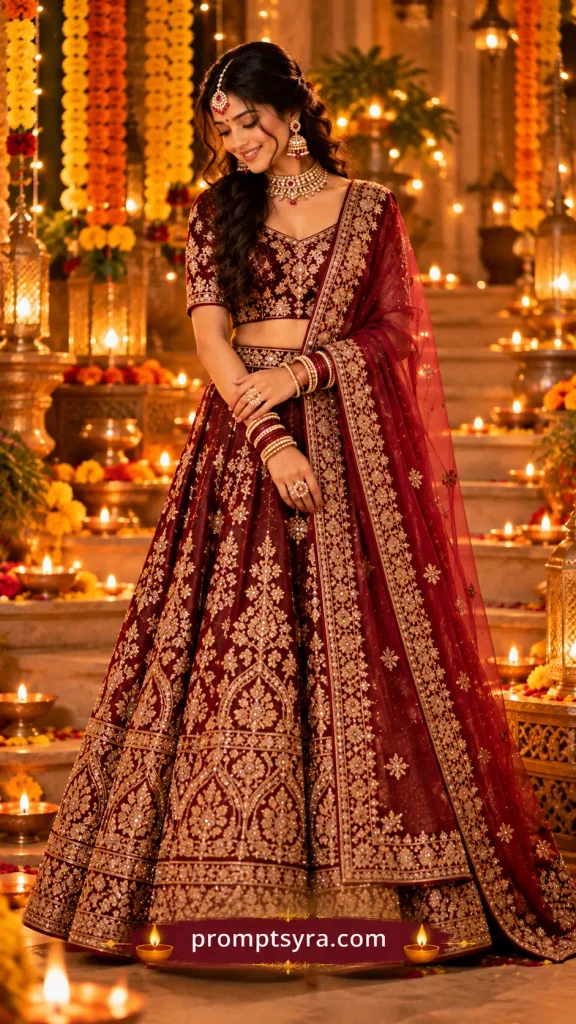
| Image Detail | Specification |
|---|---|
| Subject | Young woman, full figure or three-quarter — complete traditional look |
| Visual Style | Full traditional Diwali ensemble portrait |
| Clothing | Heavy lehenga with dupatta, full traditional jewelry set |
| Maang Tikka | Visible in frame, described in prompt for correct placement |
| Aspect Ratio | Vertical 9:16 |
| Image Quality | High-quality, detailed, realistic image |
Realistic full-figure traditional Diwali portrait of a young Indian woman. The frame shows her from head to feet or from head to knee — a three-quarter or full-figure composition. She wears a heavily embroidered lehenga choli in a rich jewel tone such as deep maroon, emerald green, or royal blue, with a matching embroidered dupatta draped over one shoulder. Complete traditional jewelry: she wears a maang tikka (a decorative pendant centered on her forehead, attached by a chain along her center hair parting), jhumka earrings, a nath, bangles, and a necklace. Her hair is styled in a traditional bun or braid decorated with flowers. She stands in a slight three-quarter turn, one hand resting naturally. The background is a warm Diwali interior or a softly lit courtyard. Consistent jewelry placement — the tikka pendant should be on the forehead, not on the temple or nose. Output quality: High-quality, detailed, realistic image. Aspect ratio: Vertical 9:16 format.
Prompt 5: Diya Glow Background — Warm Light on Tikka Pendant
The subject is photographed with soft diya light as the primary or dominant light source in the background and around her. The warm amber glow of the diyas reflects off the gold of the maang tikka pendant and earrings. This is a lighting-led prompt — the diya atmosphere is what makes it distinct from the other close portraits.
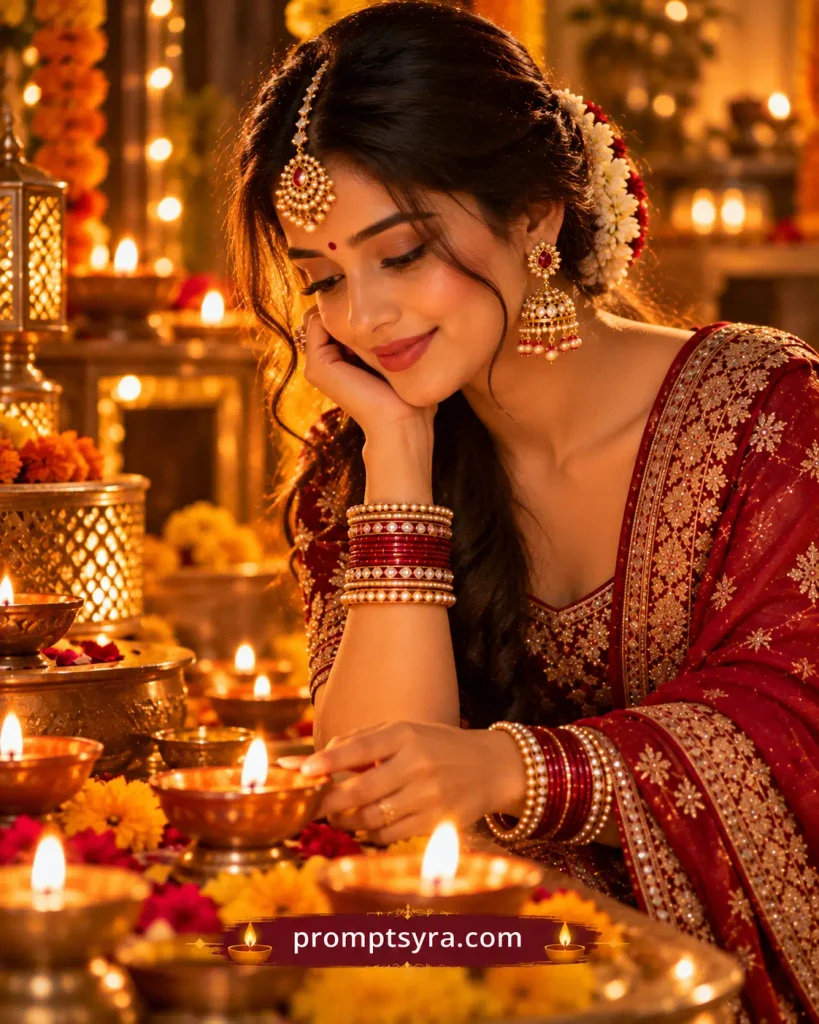
| Image Detail | Specification |
|---|---|
| Subject | Young woman, traditional look, portrait lit by diya glow |
| Maang Tikka | Gold pendant catches warm amber diya light |
| Lighting | Warm diya glow — amber and gold tones; golden jewelry reflections |
| Background | Diyas visible in soft focus behind or beside subject |
| Aspect Ratio | Vertical 4:5 |
| Image Quality | High-quality, detailed, warm-toned realistic image |
Realistic traditional Diwali portrait of a young Indian woman with warm diya light as the dominant light source. She wears a traditional maang tikka: a gold decorative pendant on her forehead attached by a chain along her hair parting. The warm amber glow from several lit clay diyas placed near her illuminates her face and catches the gold surface of the tikka pendant and her earrings, creating warm reflections. Several diyas are visible in soft focus in the background — a row on a ledge or scattered on a surface behind her. Her clothing is a richly colored embroidered lehenga or saree. She looks toward the camera or slightly to one side. The overall color palette is warm amber and gold — no cool or daylight tones. Close to medium portrait composition. Output quality: High-quality, detailed, warm-toned realistic image. Aspect ratio: Vertical 4:5 format.
Prompt 6: Natural Window Light — Tikka Catches Daylight
An indoor daylight portrait by a window. Soft natural light from one side illuminates the subject and catches the maang tikka pendant with a cooler, cleaner light than the diya shots. The window light creates a natural falloff — the near side of the face is well-lit, the far side softer. This prompt covers the clean editorial aesthetic rather than the warm festive one.
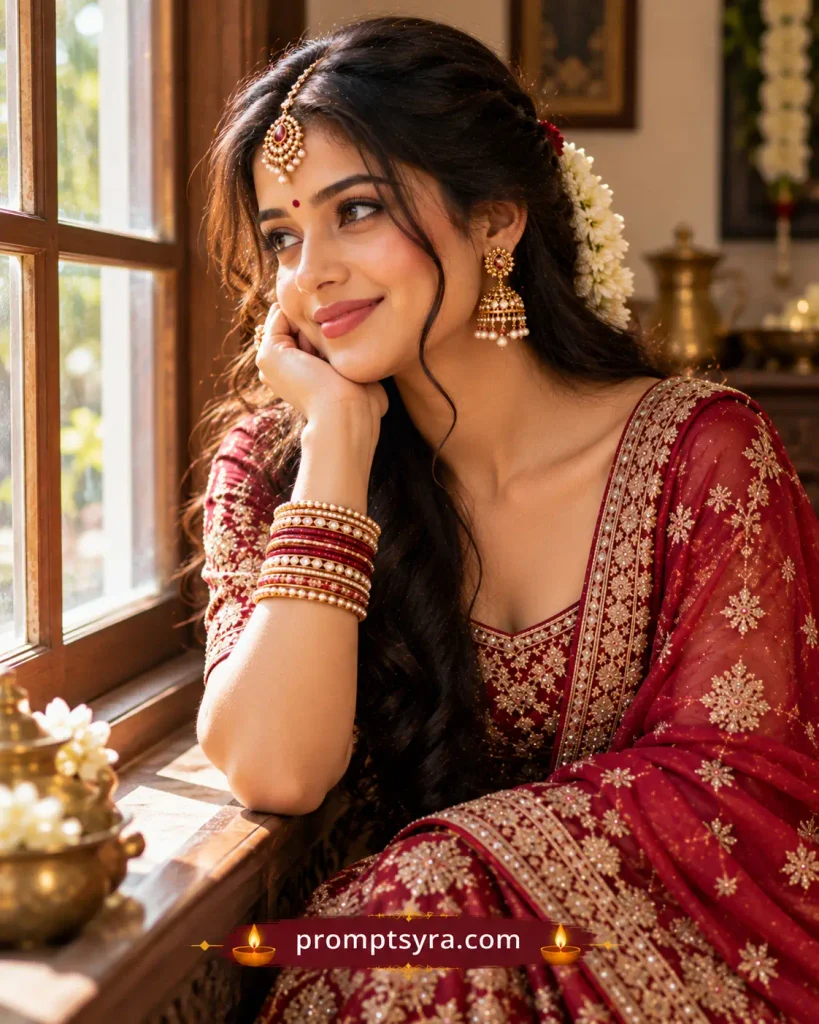
| Image Detail | Specification |
|---|---|
| Subject | Young woman, traditional look, natural window light portrait |
| Maang Tikka | Gold pendant catches clean daylight from window |
| Lighting | Single natural window source from one side; soft falloff |
| Background | Indoor — window visible or implied; simple interior detail |
| Aspect Ratio | Vertical 4:5 |
| Image Quality | High-quality, detailed, realistic image |
Realistic traditional portrait of a young Indian woman standing or seated near a window in natural daylight. She wears a traditional maang tikka: a gold decorative pendant on her forehead, attached by a chain running along her hair parting. The pendant catches the clean daylight from the window, creating a subtle natural glint. Soft natural window light comes from one side — near-side face is well illuminated, far side in gentle shadow. Her outfit is a traditional embroidered lehenga or saree in a festive Diwali color. Hair is traditionally styled with the tikka chain visible at the parting. The background is a simple Indian interior — a wall, a wooden door, or a lattice window partially in frame — not cluttered. No warm diya tones — this is a cooler, cleaner daylight palette. Close to medium portrait. Output quality: High-quality, detailed, realistic image. Aspect ratio: Vertical 4:5 format.
Prompt 7: Mirror Reflection — Tikka Visible from Two Angles
The subject stands or sits in front of a decorative mirror. The composition shows both her face directly and her reflection in the mirror — the maang tikka is visible from two angles simultaneously. The direct view shows the tikka pendant on the forehead; the reflection may show the chain detail, side profile, or hair pin. This is a compositionally unique prompt that no other image in this collection replicates.
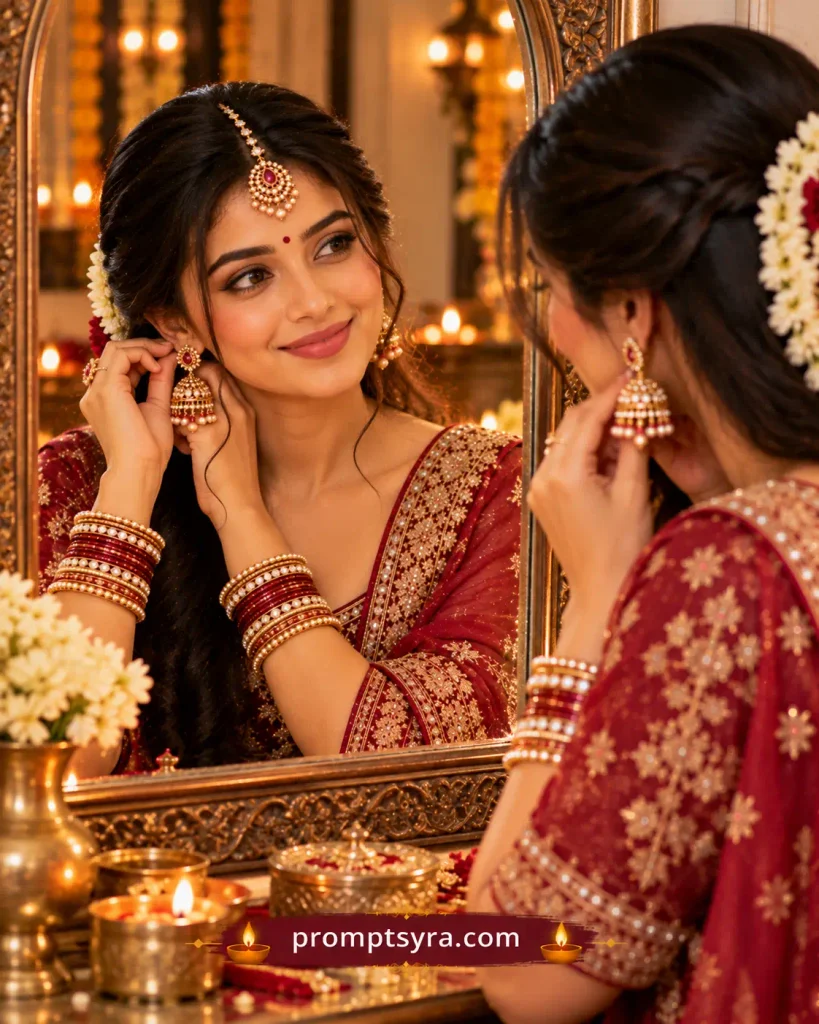
| Image Detail | Specification |
|---|---|
| Subject | Young woman before a decorative mirror — direct and reflected view |
| Maang Tikka | Visible from two angles — direct face and mirror reflection |
| Visual Style | Traditional portrait with mirror — double-angle jewelry visibility |
| Lighting | Soft ambient — mirror reflection should be clear, not overexposed |
| Aspect Ratio | Vertical 4:5 |
| Image Quality | High-quality, detailed, realistic image |
Realistic traditional Diwali portrait of a young Indian woman standing or seated before a decorative antique or ornate mirror. The composition shows both her face directly (toward camera) and her reflection in the mirror behind or to one side of her. She wears a traditional maang tikka: a decorative pendant centered on her forehead, chain running along her hair parting. The direct view shows the pendant on her forehead; the mirror reflection reveals an alternate angle — perhaps the profile view, the chain detail, or the hair styling. She wears a richly embroidered lehenga or saree with full traditional jewelry. The mirror frame is decorative — carved wood, brass, or ornate metal. Soft, even ambient lighting so both the direct face and the mirror reflection are clearly visible and neither is washed out. Output quality: High-quality, detailed, realistic image. Aspect ratio: Vertical 4:5 format.
Prompt 8: Extreme Close-Up — Jewelry Detail at the Hair Parting
This prompt is not a face portrait. It is an extreme close-up of the maang tikka itself — the chain at the hair parting, the pinpoint in the hair, and the pendant where it begins to fall toward the forehead. The subject’s full face is not the subject of the image. This is a jewelry detail shot — for readers who want to showcase the ornament itself rather than the full look.
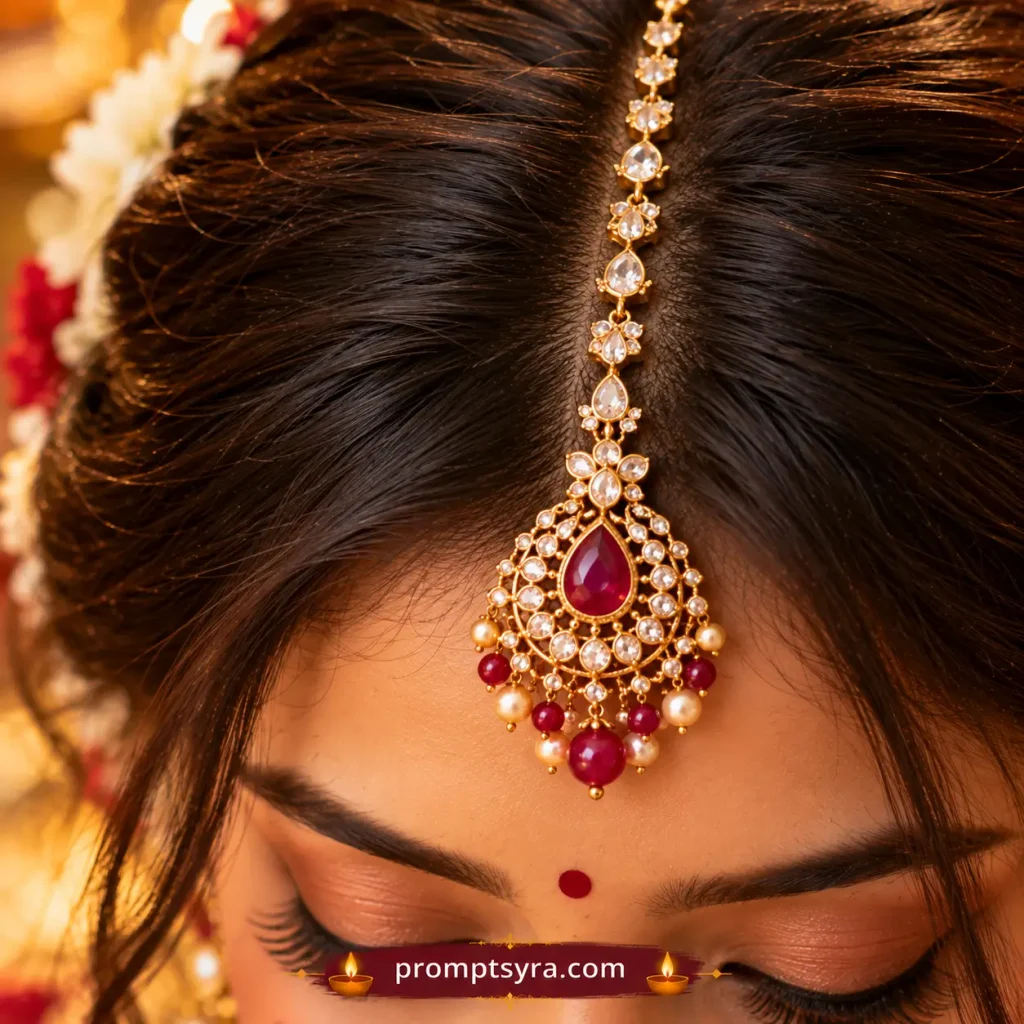
| Image Detail | Specification |
|---|---|
| Subject | Extreme close-up — maang tikka chain and pendant at hair parting |
| Visual Style | Jewelry macro detail — hair parting focus, not face portrait |
| Lighting | Soft light that reveals gold detail and chain texture |
| Composition | No full face — tight frame on tikka, chain, and upper forehead |
| Aspect Ratio | Square 1:1 |
| Image Quality | High-quality, detailed, macro-style realistic image |
Extreme close-up macro-style jewelry detail photograph of a traditional maang tikka. The frame is tight on the tikka chain as it runs along a woman's hair parting — the chain detail, the hair parting itself, and the point where the chain is pinned into the hair are all in frame. The pendant begins to appear at the lower edge of the frame where it falls toward the forehead. This is not a face portrait — the full face is not the subject. The focus is the jewelry detail: the gold chain texture, the hair parting, and the upper edge of the decorative pendant. The hair is dark, traditionally styled, with a clear center parting. The background is the hair and the soft warm skin tone at the forehead edge. Soft, even lighting that reveals the gold texture and chain links clearly. Output quality: High-quality, detailed, macro-style realistic image. Aspect ratio: Square 1:1 format.
Prompt 9: Movement — Lehenga in Motion, Tikka Swaying
The subject is captured mid-movement — spinning or turning, her lehenga fanned out around her. The maang tikka pendant is slightly displaced from the motion — it may be swaying or at a slight angle. The dupatta and lehenga are in motion. This is a dynamic, kinetic prompt that contrasts with all the static portrait compositions above.
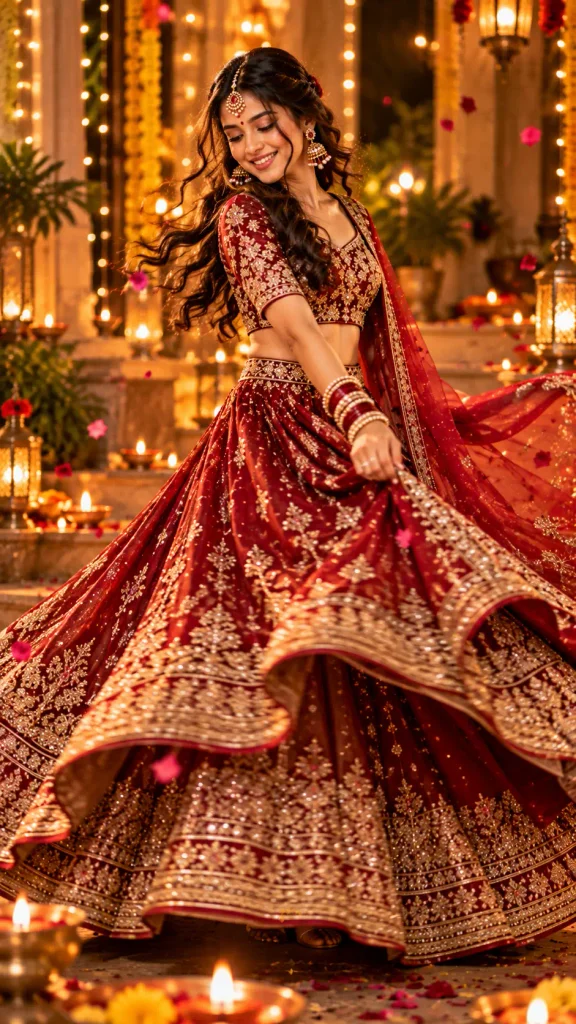
| Image Detail | Specification |
|---|---|
| Subject | Young woman mid-spin or turn — lehenga in motion |
| Maang Tikka | Pendant slightly displaced from motion, chain swaying |
| Visual Style | Dynamic Diwali portrait — motion and traditional jewelry |
| Lighting | Warm ambient or Diwali festive light — motion freeze preferred |
| Aspect Ratio | Vertical 9:16 |
| Image Quality | High-quality, detailed, cinematic image |
Dynamic traditional Diwali portrait of a young Indian woman captured mid-spin or turning. Her lehenga is fanned out around her from the movement — the embroidered skirt is in motion, the dupatta flows outward. She wears a traditional maang tikka: a decorative gold pendant on her forehead attached by a chain along her hair parting. The pendant is slightly displaced or swaying from the motion. Her expression is joyful. The image captures motion — the fabric and the tikka pendant are both mid-movement. The background is warm and festive — a slightly blurred Diwali interior or courtyard with warm light. The composition is vertical with enough space around her to include the full span of the lehenga in motion. Warm amber festive lighting. The image should feel dynamic and celebratory rather than stiff. Output quality: High-quality, detailed, cinematic image. Aspect ratio: Vertical 9:16 format.
When the Maang Tikka Renders Incorrectly — Targeted Fixes?
Problem: The tikka looks like a bindi or face sticker. This means the AI has rendered a flat forehead mark rather than a hanging pendant. Fix: Add this sentence explicitly — “The maang tikka is a piece of jewelry, not face paint or a bindi. It consists of a gold pendant that hangs from a chain in the hair; the chain runs along the hair parting, and the pendant rests against the forehead from above.”
- Problem: The chain is not visible or appears as a headband. Add: “The tikka chain runs along the center hair parting from the pendant upward, visible as a thin gold chain in the hair.”
- Problem: The pendant is on the wrong part of the face — temple, nose, or cheek. Specify the exact position: “The pendant is centered on the upper forehead, approximately where the hair parting begins.”
- Problem: The overall jewelry set looks inconsistent — earrings don’t match the tikka style. Specify a matching set: “She wears a coordinating traditional jewelry set: the maang tikka, matching jhumka earrings, and a necklace are all in the same gold and gemstone color family — for example, all gold with deep red stones, or all gold with emerald green stones.”
- Problem: Hair styling obscures the tikka chain. Specify a suitable hairstyle: “Her hair is styled in a center-parted low bun or braid — the center parting is clearly visible, and the tikka chain runs along it without being hidden by loose hair.”
Conclusion
The most common failure point in a traditional Diwali look with a maang tikka AI photo prompt is imprecise jewelry description. Specifying the pendant, the chain, the hair parting, and the exact forehead position in one or two clear sentences prevents the most common misrenderings — flat bindi-like marks, misplaced pendants, and invisible chains. The sentence template in the opening section of this article can be dropped directly into any of these 9 prompts if you want to reinforce that detail.
Each of the 9 prompts covers a distinct visual goal, including close portraits, full-figure looks, different lighting scenarios, jewelry detail shots, and a dynamic motion portrait. Choose the composition that best matches your intended use, then apply the refinement tips above if the first result needs adjustment.